…[sigh]… “Junior Speedsters are our lives, skybound soars and daring dives…”



Episode written by Cindy Morrow
Entirely unofficial reflections by sixcardroulette
This is a full-length Ponywatching essay. For a condensed review
of this episode, check out The Shorter Ponywatching!
Hold on, Episode 5? What gives? Shouldn’t The Ticket Master, episode 3, be next up?
Well, yes. Yes it should. But actually, this is the third episode I ever saw. You see, I’m British, and I first watched My Little Pony: Friendship Is Magic this Christmas just gone, when my daughter got the newly-released Season 1 DVD for Christmas and we all sat down to watch it together.
(Newly-released? Yup. The show premiered in the US in October 2010. The British DVD of Season 1 came out in November 2014, over 4 years later. For once, that’s not a typo. We still can’t legitimately watch Seasons 2-4 on DVD, or buy episodes for download.)
Anyway, we were visiting my parents for the holidays and had limited Internet access, and the strange order does still make sense, sort of, so it took us a while – probably a good twelve episodes or so in – to realise that we were watching the episodes in completely the wrong order, because the running order of the UK Season 1 DVD set has deliberately been jumbled up. So, yeah, the third episode I ever saw is actually this one. Hence: Episode 5. It gets even more confusing soon. Stay with me, guys.

You Are So Random
Essentially, as far as I can tell, what happened is that the company who had the rights to produce UK MLP DVDs started out releasing themed single-disc “collections”, little compilations of five or six episodes with a vague theme, and released all of their stockpile of Season 1 episodes that way. As I understand it, the company then went bust, and a new company picked up the rights, including a commitment to getting the complete Season 1 DVD set in the shops by such-and-such a date. The drawback? The only English R2 disc masters they had access to were the five compilation discs, so that’s what went in the box set.
All of that led to a slightly weird viewing experience for me and my family – most noticeably when characters we’ve already met are formally introduced, something I initially put down to the usual sloppy approach to storytelling in kids’ TV (there’s a lot of it out there, childless bronies!), even as I’d begun to realise this show had rather higher standards than that.
Anyway, the themed titles for each disc are, in order: Welcome to Ponyville, Call of the Cutie, A Pony Party, and then – apparently inspiration runs out a bit here – Sonic Rainboom and Green Isn’t Your Colour, which were belatedly released together as a twofer package while the distributor was circling the drain. The discs weren’t shoved together completely at random – A Pony Party in particular was compiled with some care, tracking the Grand Galloping Gala storyline that runs through the series and presenting the episodes in a logical order, while Call of the Cutie unsurprisingly collects all of the Cutie Mark Crusaders’ episodes on one disc, again in something approaching the right order – but nonetheless it’s very much still the wrong order, and the theme of that fifth disc just seems to be “Random Odds and Sods we Didn’t Already Collect Elsewhere”. As for what else is on this first disc, which doubles as the first MLP DVD released in the UK? Wait and see.
Oh, yeah, the episode. Right.
Cup of Tea and a Slice of Life
It actually works rather well as an accidental third episode, this one.
For a family rather unsure of ourselves over whether we should be watching My Little Pony at all – me and my wife uneasy as parents as to whether we were setting a bad, explicitly gendered example, the kids being presented with something they’d never seen before – the opening two-parter served its purpose, drew us in, assuaged some of our most outlandish fears, and we were all intrigued enough (and enjoying it enough!) that we agreed to watch the third episode later that same day. After we’d watched this one, which subtly bumped the narrative along and knocked everything up a notch in terms of getting a handle on the “feel” of the show, we were drawn in yet further.
Watched third up, Griffon The Brush Off presented our first example of what I know now is called a “slice of life” episode, i.e. focussing not on some epic threat but on the daily lives of the individual characters, and their (relatively) more mundane daily struggles and dilemmas. The approach, which forms the foundation for the bulk of episodes we’ll see here on Ponywatching over the coming months, provides child-friendly takes on a range of evening teleplay setups, from sitcoms (whether farcical, cerebral, ensemble or whatever) to small-scale kitchen sink dramas.
It makes sense enough – the domestic scenes in the opening two-parter having (for me!) worked a bit better than the fairytale adventure stuff, for one thing, while the gimmick introduced in those opening episodes (recently-relocated magical unicorn Twilight Sparkle writes weekly reports on what she’s learned about friendship) has increased relevance to the lives of watching children for having been drawn from more realistic and familiar situations. Although this one does still features a mythological beast as its antagonist and main plot device; we’re not quite approaching the comedy/dramedy/homily of an adult equivalent just yet. (What would the “for adults” equivalent of My Little Pony even be, anyhow? I’d guess it would come out as something like Scrubs meets Buffy the Vampire Slayer, only, y’know, better than that sounds?)
Anyway, this is a digression for another day, isn’t it? Let’s get to grips with Griffon the Brush Off.

In which Pinkie Pie is Pinkie Pie,
and Rainbow Dash is exasperated
So! Following directly (as I saw it, remember!) from the end of that opening two-parter, Mare in the Moon/Elements of Harmony, where we saw Twilight Sparkle first acknowledging her five new friends as such, and then asking for – and getting – the opportunity to stay in Ponyville, the viewer is left in an uncertain place. The feeling I got was that those friendships were just beginning, rather than already firmly established (at least not necessarily six ways and in both directions); the relationships are tentative and new, the group’s complex web of who knows and likes who is still unequal, and despite all she’s been through, Twilight’s character hasn’t had time to change very much from the “bookish loner” personality the writers introduced before her move.
As if to underline this last point, in the cold open, we once again see Twilight engrossed (or trying to be engrossed) reading a book – almost an exact callback to the way we first met her in the cold open to Mare in the Moon.
But there’s a twist, too; while she’s trying to read, Pinkie Pie is talking to her (or rather at her), while doing her best impression of a hyperactive child who’s eaten a bag of icing sugar:
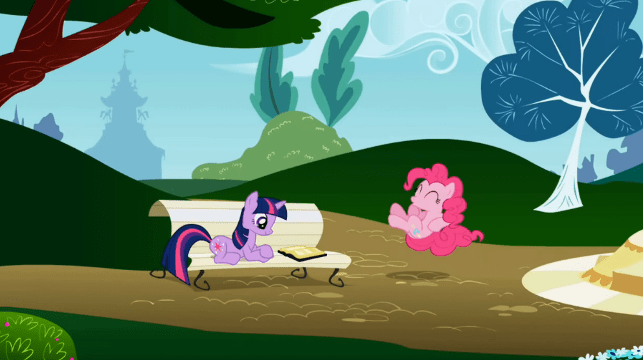
I love everything about this picture.
Friendship is a two-way street – actually, that’s kind of an additional moral of this episode, I guess – and these early instalments, in the order I saw them, are largely about how the characters wind up reciprocating each other’s friendships. If the show itself is set out as the story of how Twilight Sparkle makes friends, at least to begin with (and reinforced by the lyrics to the theme tune!), that web of interactions hints at five other shows that we could be following; at the end of Elements of Harmony, I’m taking it as certain that not all of the Mane Six perceive themselves as being equally strong friends with either Twilight or each other.
I’ve no wish to spend the time working out theoretical power rankings for all the individual permutations of those friendships, but I’d say two things with some degree of certainty. Where we left them in Elements of Harmony:
- Pinkie likes Twilight more than Twilight seems to like Pinkie; and
- Twilight’s relationship towards Pinkie felt like the weakest – and least likely – of the five new friends she’s made.
There’s no one moment (that I can remember offhand, anyway) where Twilight crosses over and finally warms to Pinkie; it’s more of a gradual thing, as the six become more and more of an inseparable gang and Twilight learns to just roll with her new friend’s eccentricities just as surely as Pinkie rolls with hers. It takes time, though (and given the wonky order in which I saw these episodes, it feels like it takes even longer), and we’re not there yet. But I suppose this is progress – Pinkie being Pinkie, she just wanted to hang out with Twilight, and Twilight either couldn’t say no, or couldn’t get rid of her. As we’ll see in later episodes, Pinkie’s go-to friend-making technique is part astonishingly thoughtful gestures, and part bludgeoning the recipient into submission. Twilight, on the other hand, has never had cause to develop any kind of friend-making technique at all.
I remember being struck straight away by the impressively realistic approach the creators seemed to be taking: a slow and not necessarily smooth buildup, resulting in what feels like a natural developing relationship, with the attendant payoff that that friendship feels stronger having been shown rather than told. Better that than a sudden, out-of-character 0-60 from “you’re a buffoon” to “let’s braid each other’s manes!”, the sort of thing that might well have been a factor in the 80s cartoon (and royally cheesed off a watching Lauren Faust in the process). It all feels so natural – not just this scene between Pinkie and Twilight, but the web of interactions between Pinkie and her newfound friends throughout the episode – that I was really surprised to discover later this wasn’t actually the third episode.
But here’s a sweet thing – what’s Pinkie yammering on and on about? She’s waxing lyrical on how TOTALLY AWESOME Rainbow Dash is, sounding more like an awestruck sports fan than a close personal friend who just accompanied her on a world-saving quest. In her mind, her work’s already done, and she’s talking to her new best friend about her other new best friend.
The resulting scene is just a delight – Twilight is doing her level best to humour and otherwise ignore Pinkie’s manic babbling (which at one point causes Pinkie to actually hover off the ground – between this and her behaviour at the end of Elements of Harmony, in particular her spectacular cartoon tears and breaking the fourth wall, we’re already getting a sense of Pinkie’s Looney Tunes relationship to physics), while Pinkie herself is either completely oblivious or just doesn’t care – she just keeps on going and going.
Hoof-biting action overload! She was like a stunt SUPERSTAR, flying higher, and higher, and then Rainbow Dash swooped down – SWOOOOSH! – and right before she hit the ground, PSCHOOOM! She pulled up! VROOOOOOM!
… Uh-huh.
And then she LOOPED around and around, like WOO WOO WOO WOO WOO WOO WOO… [falls over]
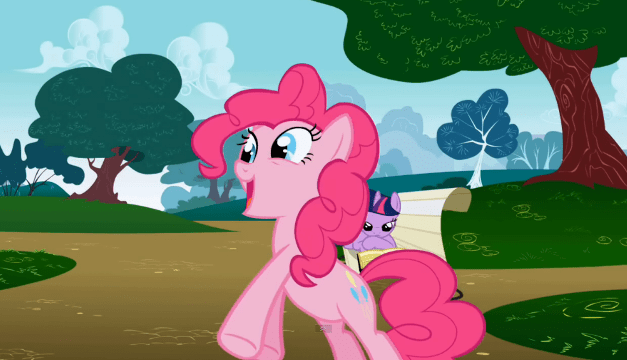
Uh-huh.
Not only is it pretty funny (Andrea Libman and Tara Strong both deliver and time their lines with the exact perfect amount of cloud cuckoolander excitement and bored disdain respectively), but it shines light on both characters; for Twilight this is progress, like I said, and for Pinkie, we’re getting more pieces of the puzzle. Pinkie’s overwhelming desire for friendship, her mission to spread joy, goes to the very core of her character, and the feeling conveyed just in this first (for me) post-quest scene is that she’d find it extremely difficult to dial it down a notch, with potentially unsettling consequences.
Then Pinkie spots Rainbow flying overhead, and rushes off to catch up to her, finally leaving Twilight in peace.
(It’s really strange, watching this back now, to see Twilight manually turning the pages by hoof (or actually, in this scene, muzzle) rather than by magic, though it results in a nice (and I assume intentional!) little animation moment: after Pinkie has finally left her alone to read, Twilight noticeably turns her page back instead of forwards, as if she needs to re-read what she just went over because she couldn’t concentrate thanks to Pinkie’s endless yapping.)
So Pinkie shouts up for Rainbow, and it seems Twilight isn’t the only pony with little time for the manic genki girl who’s somehow ended up in their group:
Ughhh, Pinkie Pie? Not again!
Cue some physical comedy – always a winner with my children, and they laughed out loud here! – as Pinkie tries to chase down the evasive Rainbow Dash (at one point breaking into a really quite stunning animated gallop) with increasing urgency:
But… but… Rainbow!
(*sickening thud*)
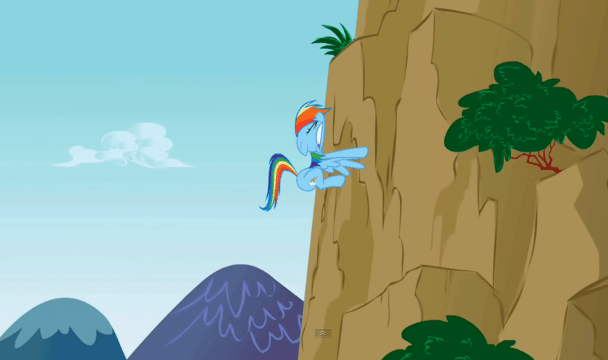
(*collective wince from entire family*)
I was gonna tell you to look out for that mountain.
(Badoom-tish. Theme music.)

In which Pinkie Pie and Rainbow become true (true) friends,
and Gilda the Griffon is introduced
It’s a nice, well-written comedy scene, well-paced, and it picks up exactly where these characters are at this point of their various relationships. Indeed, the scene can only work at this point in their relationships, as Pinkie and Rainbow (who, let’s not forget, just saved the world together via the power of friendship) are about to become friends with each other for real.
Pink Flag
Pinkie Pie was probably the main pony we came out of the opening two-parter knowing the least about. I imagine she’s both fun and difficult to write for, having to be neither too random, nor not random enough, to fit into any given scene, while both getting the laughs and also staying true to her character. The temptation to make her a cardboard cut-out must be strong, and it’s not always successfully resisted.
But I like her. I like that the show finds the room to develop her as a real, rounded character, rather than a mere punchline generator: not just an annoying jester yukking it up at inopportune moments, but a pony you can actually imagine the other ponies realistically being friends with. At this stage, that hasn’t happened yet – I know I said something similar in one of the earlier pieces, but in the premiere it’s made obvious Pinkie is actively getting on Twilight’s nerves more than once, and it felt as though Twilight – the brusque, asocial Twilight who first arrives in Ponyville from the safety of her library, I mean – might prefer to have her committed as a danger to herself and others, rather than forge a lifelong friendship. While we’re clearly making strides here in the cold open – Twilight and Pinkie are technically “spending time together”, after a fashion – nonetheless, we can’t get rid of those quote marks quite yet.
But the whole point of the show is that friendship transcends artificial boundaries – different kinds of people can form the best friendships, become the best friends. One of the most impressive things about the show, even in the wacky order I watched all these episodes, is how believable it is that such disparate personalities could wind up becoming truly close, without sanding off all their various awkward edges and sacrificing those personalities for the sake of the plot. Pinkie Pie is the epitome of this, in that early season 1 Pinkie doesn’t strike me as so very different from early season 5 Pinkie – it’s the attitudes of her friends which really develop.
So Pinkie ends up being the wildcard of the group, in so many ways; out of all the readily-grasped three-second pen portrait personalities of the Mane Six, if Rainbow is the hotheaded tomboy, Applejack the dependable workaholic and voice of reason, Rarity the posh girl with a good heart, Fluttershy the timid animal lover, and Twilight the intellectual and reluctant but natural leader, well, where does that leave Pinkie?
The answer’s easy enough: she’s the clown. The joker, the predictably unpredictable one, the non-sequitur delivery system, the silly one. If the script calls for one of the characters to do something especially cartoonish or fourth-wall-bending, give it to Pinkie Pie! Bouncing along on Planet Pinkie, only loosely tethered to reality, her wacky antics are easily handwaved away even by discerning viewers with a shrug – what do you expect, it’s Pinkie Pie! She’s nuts.
And yet there’s a real character in there, with real feelings that are capable of being really hurt (the writers quickly grasp that, firstly, few things hit harder than the tears of a clown, and secondly, you can’t keep doing it too often or it loses its punch because she’s no longer a real clown, so only use Sad Pinkie sparingly!)
It all goes to show just how much care is taken with the writing of this show; with just a little less creative oversight, Pinkie could have been a one-note running gag, Derpy with lines. But the writers take numerous opportunities to explore why the genki girl is the way she is, at the risk of undoing her as a joke character, or making her toys less popular when Hasbro might have been just as happy with the two-dimensional giggly party girl who loves balloons and silly hats.
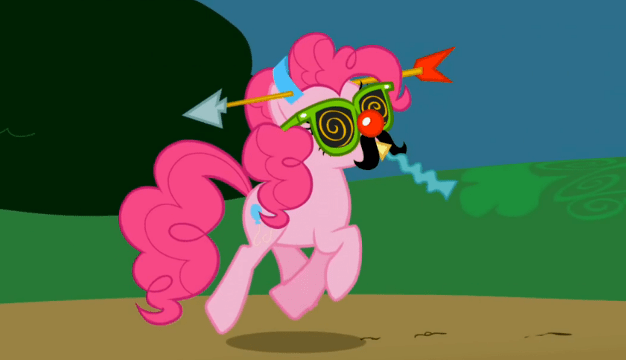
Yeah.
Put simply: when she’s badly written, usually because she’s playing a background role in someone else’s story and the writers needed an off-the-shelf gag, Pinkie’s PARTY! PARTY! PARTY! personality and supreme lack of tact can grate. When she’s the focus of her own stories, on the other hand, and her motivations are laid bare? When we see her quest to spread cheer is genuinely an integral and indivisible part of who she is, and that she takes friendship – the actual theme of the show, remember – more deeply seriously than anything else in her life? Well, I couldn’t help but warm to her. And that’s how she adds you to her ever-expanding rolodex of friends.
But she’s not realistic!, people complain, and okay, sometimes she’s not, especially when she’s just being used for a throwaway line or a Chuck Jones-esque visual joke. But she reminds me a lot of a few people I know (including my own sister) : the kind of people who would quite happily, say, attach a bunch of balloons to your door handle in the morning, or take a spectacular pratfall in a supermarket to amuse some kids, or unexpectedly break into song in the middle of the street, or empty all their spare change into a complete stranger’s vending machine and walk off, all because they thought someone needed cheering up. Those are friends everyone should have, even if the trade-off is you sometimes rolling your eyes at their antics or corny jokes. I bet the writers who do Pinkie best all know somebody like that.
On The Day The Sky Is Opened
The one running joke surrounding Pinkie is that she’s not completely subject to the rules: whether it’s the rules of the plot, or of society, or of physics, whatever rules are being applied to a given situation, there’s always a ~5% chance Pinkie will trample them. That capability is established in the pilot, the very first time we meet her (when she levitates several feet off the ground), continues when she’s blabbering nonsensically on and on at Twilight’s party (when she keeps disappearing from the frame and reappearing from another edge, some of them physically impossible), and it carries on.
It seems like it’d be a boon for a capable writer, a get-out clause to exercise the much-needed silly moments very young viewers (like my children!) love, but actually it needs to be carried out with careful restraint, or else the viewer might be encouraged to stop taking the show itself seriously, and if that happens then the whole edifice comes crashing down. The switch from “willing suspension of disbelief” to “I’m just watching an exercise in crazy, madcap surrealism with no rules” is a fatal one when we’re talking about watching a show involving colourful cartoon ponies.
There’s a subset of that joke, introduced in the opening moments of Griffon the Brush Off – briefly, that although Rainbow Dash is repeatedly established as the fastest pony in the show and possibly the world, Pinkie Pie is nonetheless somehow able to keep impossibly catching up with her, like some kind of cute pink Terminator who just wants to be your friend – that I feel skirts those limits, really flirting with the button that demolishes the fourth wall, without ever quite pushing it too far.
(Though it gives rise to lots of fun fan theories – is Pinkie herself actually faster than Rainbow Dash, but doesn’t show it because she’s not the athletic type? Does she have special magic that lets her pick and choose from the physical world’s rich buffet of laws as to which ones she feels like obeying today? All good fun, but it does appear Pinkie has some kind of strangeness about her (beyond her often outlandish behaviour) which gives her undefined special abilities, a concept that will be played on in episodes to come.)
One of the recurring themes of this particular episode – and, indeed, one of its important moral lessons…
…incidentally, can I just digress (again) here for a moment?
After going online and discovering bronies were this huge, long-established thing, one of the first things I saw cited multiple times was that people were actually citing lessons they had learned from the show – lessons about friendship, aimed squarely at young girls, which bronies found relevant and useful in their adult lives.
I can completely understand how some of these morals could strike a deep chord with men (specifically men for the purposes of this argument) who were brought up to be tough and to shut out their feminine side lest it threaten their identity as, well, men, but I was kind of dubious as to what purpose some of the individual morals being taught might serve an adult – no matter how old the ponies themselves are meant to be, the lessons are pitched at the level of the target audience, right?
But the show’s exploration of friendship does have its uses, in the adult world, I’ve found – things which aren’t revelatory, but rather just a kind of helpful reminder, a re-primer on what friendship can and should be for those of us who’ve long since grown up, but who maybe can’t see the wood for the trees, don’t realise they’re brushing off sound advice as “Obvious Teachings For Kids (Duh)” because it’s basic, not realising it’s actually directly relevant to a given (adult) relationship situation once the method of delivery is stripped away. This episode is a pretty good example, in a number of ways. But anyhow –
…one of the recurring themes of this particular episode, and one of its important moral lessons, is that your friends’ friends aren’t automatically your friends. Firstly with Rainbow Dash and Pinkie, and later with Pinkie and Gilda, and later still with Gilda and the rest of the cast, the show underlines that one extra degree of separation doesn’t guarantee you’ll have any affinity with the person (or pony, or griffon) at the other end.
Act I begins with Pinkie asking around trying to find Rainbow Dash, who’s asleep on a cloud; on hearing Pinkie, Rainbow stuffs some cloud in her ears to block out the annoying sound, before realising Pinkie is actually looking for her; first she tries to hide, and then tries to run away in panic. They aren’t really friends just yet, it’s safe to say.
The resulting comedic chase sequence which opens the first act, Pinkie literally hunting a reluctant Rainbow Dash down (all but shouting PLEASE BE MY FRIEND!) until Rainbow gives up and gives in, is kind of sad if you go back and look at it in a certain way – as far as I’ve seen thus far (and I don’t think there’s anything in the two “missing” episodes to counter this – the baking scene in Applebuck Season, maybe, where she’s unusually cast as the straight man (…woman? …pony?) and poor sleepy Applejack is the comic relief?), Pinkie’s interactions with other ponies have always been on a very open, simplistic, almost childlike level.
Perhaps as a result of her childish air of innocence, being a parent myself I feel sorry on her behalf when she just can’t (or won’t) understand – and understand why – Rainbow Dash flat out doesn’t want to spend time with her. It’s not even that Pinkie can be reassured it’s not her, she’s done nothing wrong etc. – she’s being annoying to the point other characters explicitly comment on it in-universe, and it’s not Rainbow’s fault the result is annoyance.
But this is Pinkie Pie we’re talking about here, and resistance is futile.
One Way Or Another
Possible emotional undercurrents aside, that opening “chase” sequence is a joy, a Road Runner short that’s been almost seamlessly glued into the ponyverse; the normal rules are bent or suspended and we go full cartoon, and it works because the show totally commits to the stylistic tone change, recreating the madcap, anything-goes fun of an old Silly Symphony skit. Things like this don’t happen very often, and when they do, Pinkie Pie is usually involved.
So, here, we get her chasing down Rainbow Dash, who – following the pattern laid out in the cold open – still plainly doesn’t want to be bothered by whatever inane thing Pinkie’s got on her mind. Rainbow zooms off at high speed, rock music playing, jagged rainbow trail cutting through the sky; Pinkie follows, seemingly in no great rush, bouncing along serenely (all four hooves off the ground each time, complete with audible “boing!” noise, while a happy Teddy Bears’ Picnic tune plays in the background… and keeps catching Rainbow up. Every time Rainbow finally thinks she’s shaken her off, Pinkie improbably turns up right next to her, the obvious, lampshaded liberties taken with cartoon geography getting more and more blatant each time:
- Rainbow Dash jets off to Sweet Apple Acres and appears to get there in a matter of seconds. She hides behind the barn, only to find Pinkie already there.
- Rainbow Dash jets off to Twilight’s library to hide in the trees. After a moment, she realises she’s actually landed on Pinkie’s head.
- Rainbow Dash jets off across the far-off mountains in a zigzag motion, then secretly turns back on herself and flies several miles across the landscape at top speed, ending up on a deserted lakeshore seemignly miles from civilisation. As she pants from exhaustion, Pinkie emerges from the lake, complete with snorkel and flippers.
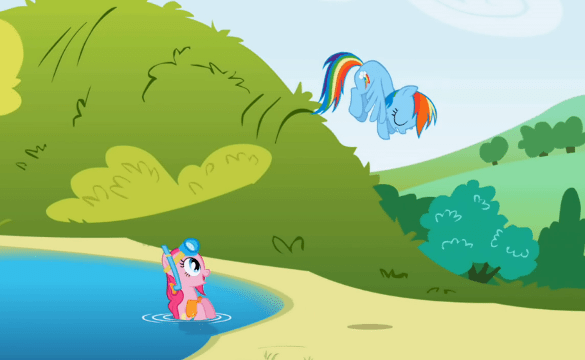
I love that Dash briefly considered making a fourth doomed run for it here, before accepting her fate.
So, eventually, Rainbow gives up, and it turns out all Pinkie wanted was a favour.
Pranks 101
The way to Rainbow’s heart, it turns out, is via her sense of humour. Pinkie wanted Rainbow to set up an elaborate prank at Spike’s expense, though she doesn’t explain this at first; we jump to a scene of Pinkie, directing from the ground, requesting the airborne Rainbow make a seemingly endless series of minor adjustments to the positioning of a thundercloud –
– and it turns out to be a practical joke, the painstaking setup for which doesn’t really earn a payoff. Rainbow makes the cloud thunder, Spike (who is humming the theme music!) gets startled, Spike gets the hiccups, Pinkie falls about laughing.
It’s a side of Pinkie we’ve not seen before, or indeed really seen since; a very slightly cruel streak to her humour which feels out of character in retrospect once we get to know her better. Still, Spike takes it in good cheer, and Pinkie and Rainbow find it hilarious. As for us viewers, my youngest daughter found it funny becuase she finds hiccups inherently funny, but for the rest of us, the reaction was more meh until the writers add a funny twist. We established in the first episode that in order to send letters to Princess Celestia, Spike is able to breathe fire on them and have them magically appear at her end (and for no well-explained reason, he’s required to belch up any responses received); with the hiccups, he accidentally sends a scroll to the Princess, and (excellently) we see it arrive at the other end:
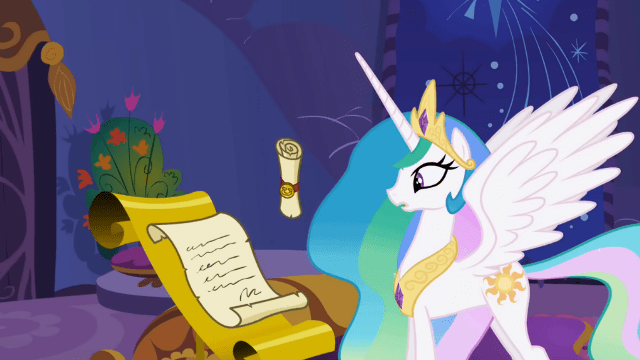
(I’m glad she doesn’t have to burp them up. Most undignified.)
…and then (after some clarification that he’s not hurt), Spike hiccups again and sends a whole stack of scrolls, with predictable results:
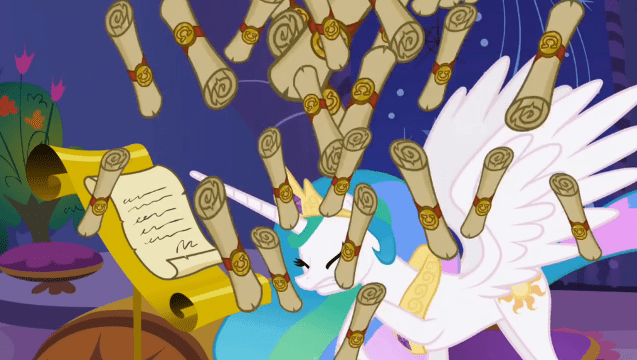
She needs a spam filter.
Unlike most of the pranks that follow, I actually found this bit really funny – I can actually imagine Cindy Morrow (or whoever came up with this gag) laughing as they wrote it. Rainbow Dash is similarly impressed, and compliments Pinkie on a well-executed prank with the best backhanded compliment one can imagine:
I didn’t take you for a prankster, Pinkie Pie!
Are you (hic!) KIDDING? (hic!) I love to pull pranks! It’s all (hic!) in good fun, and Pinkie Pie lo- (hic!) -oves to have (hic!) fun! (hic!)
Y’know, Pinkie Pie, you’re not as annoying as I thought.
So, it’s time for Rainbow and Pinkie to make friends… after Rainbow checks one last thing, a feature from the premiere. You can be Rainbow Dash’s friend, and even her partner in crime pranking, but first of all, she’s got to be sure that you can take a joke as well as dish it out. We saw it with Twilight Sparkle in Mare in the Moon, where Rainbow decided she could get on with Twilight after the latter shrugged off being blasted with mud, rain and gale force winds; we see it here now with Rainbow giving Pinkie another bout of the hiccups and testing her reaction.
Pinkie passes the test, to both her and Rainbow’s delight, even as her hiccups and excitement are causing her to bounce uncontrollably off the ground and around the screen mid-sentence (and even mid-word); she can take a joke alright. This will prove to be important later in the episode, though I didn’t consciously pick up on it at all the first time around.
You wanna hang out? … A simple nod will do.
Pinkie is overcome with joy. Joy, and hiccups. Rainbow’s little eye-rolling shake of the head while Pinkie pinballs in and out of the frame is almost an aside, a lovely little shared moment with the audience; they’re friends now, but Pinkie Pie is still, well, Pinkie Pie, and all that entails.
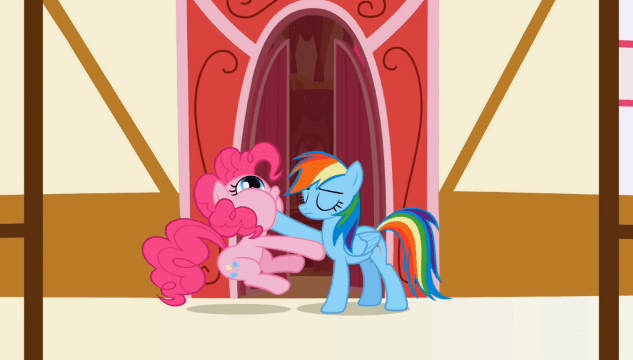
(Also, the tiny flinches Rainbow makes every time Pinkie hiccups are fantastic.)
Now, to the joke shop!
Pranksters, Inc.
I’ll get into this question a lot more on the next episode, but briefly… how old are our ponies meant to be, do you reckon? Throughout this episode, they’re basically schoolchildren; the nature of the pranks, the distinctly childish party we see later, the visits to the joke shop (although I can well imagine Pinkie Pie being exactly the kind of adult who still goes to a joke shop for sneezing powder and Groucho Marx glasses when she’s 50). I’m guessing pony culture is just different and ponies enjoy “childhood” pursuits as much as “grown-up” ones, with nopony to call them out on it; maybe Equestria is just the sort of place where ponies can act like big kids all the time if they want to.
Anyway, Pinkie and Rainbow cement their newfound friendship by going on a spree of practical jokes. The pranks they pull run the gamut in terms of how elaborate or dangerous they are, as well as how amusing the audience finds them; my children weren’t particularly chucklesome at any of them, but the important thing is that Pinkie and Rainbow are in stitches at their own antics, and their friendship builds up with each successive pranking. Each prank is quickly followed up by the “victim” either smiling in acknowledgement, or in the perpetrators getting their comeuppance (or both), which is important as it suggests the pair of them are only doing things they know will be well-received or ultimately harmless.
So, the pranks range from innocuous schoolroom classics from the 1950s like delivering a bouquet to Rarity which is full of sneezing powder, to potentially dangerous things like swapping out Twilight’s ink bottle for disappearing ink during a volatile chemical experiment – although the look of panic on Twilight’s face is kind of funny:
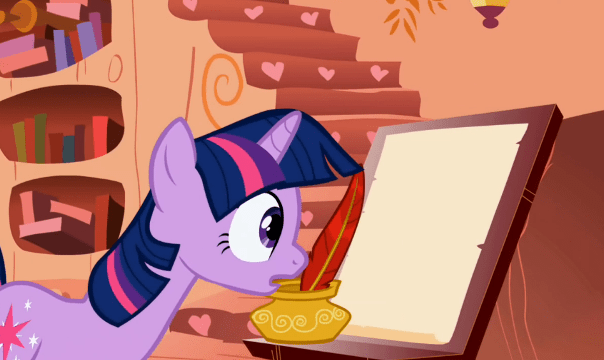
Remember, kids, do try and mix as many random chemicals as you can!
…to something just impressively, pointlessly impractical, like painting all of Applejack’s apples in bright colours as far as the eye can see (and then posing with berets and palettes), solely for the purpose of provoking a baffled “Land’s sakes!” from AJ. The funny part of this prank for me isn’t even the prank itself – it’s the incongruity, the disconnect between the amount of time and effort it must have taken to painstakingly paint all those apples, versus the fleeting comic reward at the end. I wonder if the animators had any particular feelings about that balance.
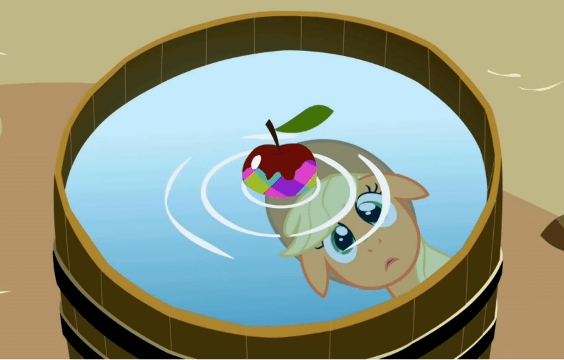
That paint had better be non-toxic, you pair of mules.
And then there’s the scene which is the heart of this section, and which (especially as an out-of-order newbie!) really helped cement some of the group’s roles in relation to each other; Pinkie Pie aborts a water-squirting gag after Rainbow reveals the proposed victim was Fluttershy.
…Yeah. You’re right. Pffffft. Huh. We need another victim, who’s made of tougher stuff. So, who’s it gonna be?
Fluttershy is Rainbow’s friend, though their relationship is uncertain at this point – she seems to get a pass from the “can take being pranked” requirement, likely on account of Fluttershy’s sweet nature and crippling shyness pretty much precluding her from pulling a practical joke, but we haven’t seen them spend time together, we don’t even at this point (I think even in the correct running order?) know that they grew up together. I mean, that’s retrospective again – you’d think it would be Rainbow who knew Fluttershy better than Pinkie Pie, having been childhood friends and all, but who knows? Rather than trying to retcon it so it makes sense in my mind, I’m simply chalking this up to that storyline not having been developed yet.
So this scene doesn’t just exist to complete the set of the Mane Six each being pranked, it also lays foundations. Fluttershy is out of bounds when it comes to having her feelings hurt; Rainbow acquiesces; the two change their plans and carry on having their fun together in a different direction.
What I really like, though, is that it shows Pinkie categorically isn’t an idiot, she’s just strange, and she seems to have trouble abiding by (or even picking up on) some of society’s unwritten dos and don’ts. She obviously doesn’t struggle to make friends, but nonetheless she suffers from a particular type of social awkwardness, a very different social awkwardness than that which afflicts Fluttershy and Rainbow Dash: hers is a difficulty reserved for gregarious extroverts, their efforts to make everyone like them underpinned by a constant feeling that they might be overcompensating for a fear that, deep down, nobody likes them.
No such worries here, mind. Pinkie, as she apparently does with every pony who ever crosses her path, has consulted her mental index and correctly established the path to eternal friendship with Rainbow Dash. No, not pranks, that’s just the way to get a foot in the door; I mean respect. Dash trusts Pinkie now, enough to acknowledge she’s right about not pranking Fluttershy; indeed, Rainbow is grateful for the advice (which, it’s implied, saves Fluttershy from the nasty fright she’d have had if Pinkie hadn’t been there to stop it; on a lesser show, this would be the chain of events which dominated the episode, concluding with a moral about taking practical jokes too far. Not My Little Pony, though; three episodes in and we’ve already seen the show avoid the clichéd paths down which its plots could have taken it.) And Pinkie confirms her place in the inner circle by pranking Rainbow Dash herself:
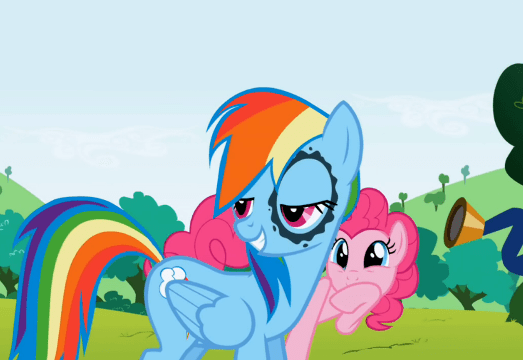
Eye eye, Rainbow Dash! (© The Big Book of Japes, Jokes and Punnery, 1934)
…which, in Rainbow’s mind, cements the friendship once and for all. Do you respect me? Can I respect you? Could we share a locker room without any issues? Then we can be friends. Welcome aboard, O crazy-ass pink pony.
Also, the “pranks” sequence ends not only with Rainbow Dash and Pinkie Pie bonding as friends, but with a funny background joke that only a show with rigorous attention to detail and respect for its audience – kids and parents! – would have bothered to animate:
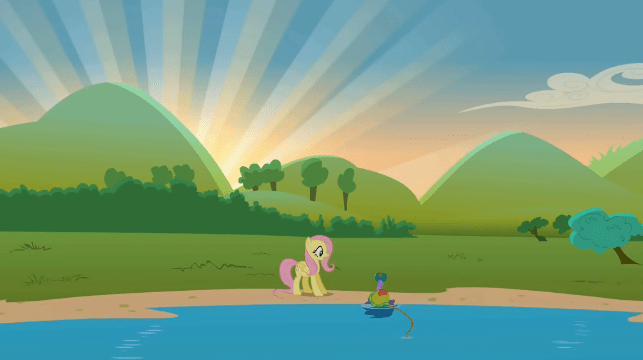
Boinggg!
Say Hello To My Griffon Friend
So then at the crack of dawn the next day, Pinkie turns up at Rainbow Dash’s (frankly enormous!) cloud house palace, only to be confronted with this:
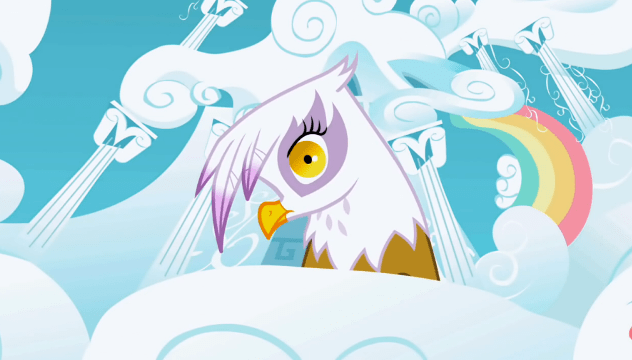
Is she going to eat me?
Gilda inspects Pinkie – and the viewer – in the weirdly anthropomorphised manner of an eagle who’s spotted a mouse, cocking her head and clocking the position of the intruder as her pupils dilate. An unexpected and briefly unsettling sight, which made us all jump a little bit on first viewing.
The first griffon we’ve seen on the show – and unlike the manticore in the opening two-parter, this time the show throws in an explanation of just what a griffon is, for the benefit of any viewers who aren’t well up on their mythological animals – Gilda turns out to be an old friend of Rainbow’s from out of town (rather than, say, the thing that’s just eaten Rainbow Dash and taken over her house).
Having her as Rainbow’s pre-existing friend is interesting: just as we saw with Spike and Twilight in the opening scenes of Friendship is Magic, we’re getting a little insight into what Rainbow’s life was like before the series began, and (again, as with Spike and Twilight), having little else to go on (especially if this is only the third episode!), we’re invited to judge RD by the company she previously kept. They apparently met at the Junior Speedsters flight camp, which is a nice universe-building touch – young pegasi, and other creatures who can fly, go to camps together.
(The significance of a presumable entire race of griffons didn’t strike me at all at this point; presented so early in the series’ run, it was just one extra piece of that same universe-building information, where the universe in question is still wet with plaster and full of unexplored corridors stretching off in unknown directions. “Huh, in this world of colourful talking horses, there are griffons too? Okay.” It was only later, when the Big List of Sentient / Not Sentient Species was starting to get filled in, that this retrospectively gave pause for thought, and in season 4 we’ll see flashes of griffon culture as a kind of little-known foreign country; apparently there’s even a season 5 episode about griffons, but as of the time of writing, we’re not there yet. And in terms of this blog, remember these early episodes are a product of a creative team who’d likely have laughed in your face if you told them there’d be a season 5. Let’s get back to them.)
So, Rainbow exhorts Gilda to join in the Junior Speedsters chant, which she does, extremely reluctantly, and the two voice performances (Rainbow’s genuine excitement and Gilda’s extreme lack of enthusiasm, conveyed perfectly by Ashleigh Ball and Marÿke Hendrikse respectively) are just hilariously mismatched; the animation is great too, but it can only convey so much of the whole package:
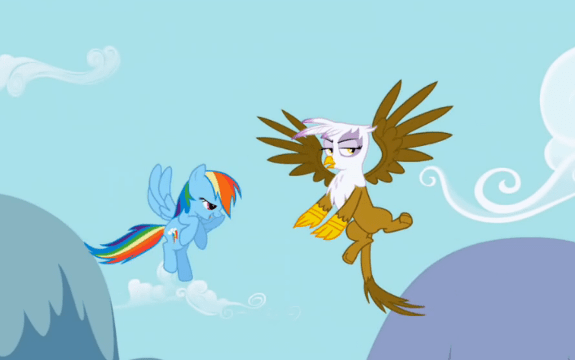
…Only for you, Dash.
I find Gilda to be such an interesting character, both in her role in the story and in the way she’s initially depicted. She veers from a well-written outside presence to difficult outsider to outright pantomime villain during the course of this episode, but there’s always a slight kernel of truth underpinning the heavily underlined moustache-twirling, however over-the-top it gets by the end.
For starters, her reaction to Pinkie Pie is the natural, irritated reaction of any newcomer to this strange pony universe upon encountering Pinkie – an initial reaction shared, let’s not forget, by Twilight Sparkle, not to mention many of the audience themselves. Further, there’s a much more universal story here: Gilda’s a visitor, a guest, she’s come from out of town specifically to spend time with Rainbow Dash, two old friends catching up and going for flights together, and anyone in that situation might be put out if some third wheel kept trying to induce Rainbow to blow her off and spend time with somepony they’ve never met instead.
And there’s an even more subtle layer of subtext going on here, too – Rainbow’s introduction of Gilda is actually worded rather carefully:
…Ashleigh Ball’s (typically excellent) delivery leaves it open to interpretation – is Gilda Rainbow’s “best friend, from my days at flight camp” (i.e. she’s her best friend and has been since they were kids), or is she her “best friend from my days at flight camp” (i.e. the best friend she made at flight camp, X number of years ago, and they’ve kind of stayed in touch since)?
Now, we don’t know what the Junior Speedsters age limit is compared to how old Rainbow is meant to be here, but it seems fair to assume it’s been a long time since they were at camp together (is it the camp depicted in Sonic Rainboom? Unlikely, since neither Gilda nor Fluttershy shows any sign of recognising the other). How much time have they spent together since then? Do they meet up every couple of weeks for a regular flight session, or have they actually drifted apart as friends in the intervening years? Is Gilda the equivalent of that old school classmate who’s friended you on Facebook and keeps inviting you to play Candy Crush? We’ve talked about Pinkie’s perception of a friendship being rather different to that of the other party; is the same true of Gilda and Rainbow? It’s clear Gilda genuinely cares about spending time with Rainbow Dash, and Rainbow Dash enjoys hanging out and participating in extreme sports together, but… Well, put simply, and leaving Pinkie out of it altogether, how insecure is Gilda about her friendship with Rainbow?
So, Gilda has ample motivation for being possessive of Rainbow in the face of Pinkie. And Pinkie is annoying – exactly as charged, she completely fails to read (or heed) Gilda’s wish to spend time with Rainbow Dash alone in favour of her own wish to hang out with her new friend, a wish which we spent the entire first three minutes of the episode establishing as needy, clingy and rude. Having not long won over Rainbow Dash to her circle of friends, Pinkie shows the downside of her genki personality with a show of quite staggering social ineptitude in assuming she’s now automatically and indisputably her best friend, shoehorning herself into a situation where – with complete justification, at this stage of her friendship with Rainbow, and having known Gilda for all of two minutes – she’s not really welcome.
All interesting and very real, and it makes for a nuanced situation which, on first viewing with the family, we all wondered where this was heading. It’s a little disappointing, then, that they fall back on an easy-way-out explanation: instead of being a complex individual with some entirely valid concerns, any of which could be extrapolated into a valuable exploration about friendship, leading to lessons about how friendships change over time, or how your friends’ friends aren’t always your friends, or how you shouldn’t judge someone on a bad-context first meeting if your friends are vouching for them, Gilda turns out merely to be a total douche.

In which Gilda shows her true colours
There’s still a lesson even in that, of course – how to deal with an abusive “friend” – and there’s still something to be said for seeing Rainbow Dash and Gilda in close proximity, and for making a comparison between the two. It’s a friendship based, it seems, mainly around two things: a mutual interest in extreme sports and a mutual athletic respect, two things Pinkie Pie was pointedly unable to call on in order to better become Rainbow’s friend and share post-workout moments like this:
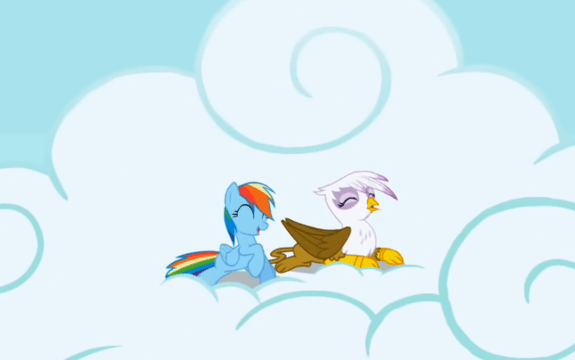
Post-workout, I said. There’ll be no shipping on this blog, thank you very much.
It’s interesting to see Rainbow around her own kind (jocks and tomboys, I mean, not griffons!), however briefly. I wrote something along these lines when discussing Elements of Harmony with regard to Rarity and Steven Magnet – you don’t see how stereotypical a character isn’t until they’re put next to someone who dials it up to 11. Rarity is set up as this effete snob who’s more concerned about her appearance than anything substantial, but it turns out she’s not like that at all, which is only really thrown into relief when we meet Steven, who really is an effete snob with an overriding image obsession.
Similarly, Rainbow Dash is set up as your average jock, an egotistical tomboy, somewhat careless with others’ feelings, lazy in the way only the extremely physically fit can be lazy, possibly even a bit of a bully. It’s only when Gilda shows up and trumps her in each of those categories that we see Rainbow painted in a more favourable light: look, here’s what Rainbow could have been like, with only a few very minor tweaks. If Steven was what a 2D cardboard Rarity might have become in the hands of worse writers, Gilda is like a dark extreme version of Rainbow Dash herself.
Gilda’s behaviour to Pinkie ramps up very quickly in the cruelty stakes, up to the point of deliberately wrecking her flying contraption and forcing the non-flying Pinkie to plummet to the ground from what looks like several hundred feet – even if we’re not supposed to join those particular dots and follow the trail to an inescapably dark place, it’s still not nice.
It’s also poorly written; leaving aside the instantly-dated and slightly cringey attempt at Young Persons’ Slang, something the show thankfully avoids most of the time in future –
– leaving that aside, even if we know Pinkie has only recently overcome Rainbow’s efforts to distance herself from her, and that none of this would have happened if Gilda had visited last week instead, well, Gilda doesn’t know the fragile, still-early nature of Pinkie and Rainbow’s relationship. So far as she’s aware, there’s nothing at all to stop Gilda being grassed up and publically confronted by Pinkie – or, y’know, the police:
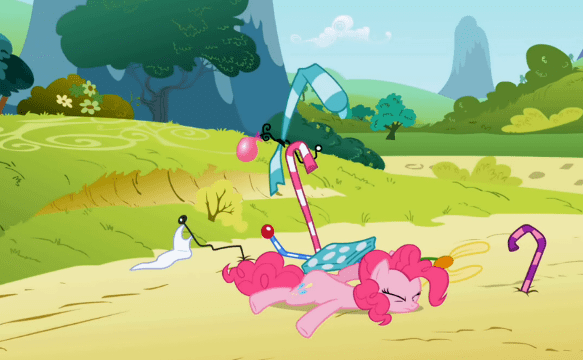
um Rainbow your psychotic “friend” just tried to murder me but whatever
She gets away with it, for now, of course. The secret conflict between Pinkie and Gilda never boils over into an open conflict between Pinkie Pie and Rainbow Dash, which might have been a hackier show’s first instinct. Indeed, much of the tension in the episode is built up because Pinkie never calls out Rainbow on her friend’s behaviour, or seeks to have Rainbow choose between them. Credit to Cindy Morrow and whoever else worked on this story, because such an artificial plot hole usually draws rather more attention to itself than happens here; instead, Morrow and company fill that hole with interesting moments that wouldn’t otherwise be possible.
So, instead of a confrontation, she chooses to keep her counsel, first by talking to Twilight Sparkle (and storming off in a huff when Twilight doesn’t share her conclusions, before reflecting on the advice she received) and then trying her best to question her potentially irrational prejudices and overcome them. It works even better when Pinkie talks to Twilight and lays out her concerns, which do sound like the ramblings of a crazily insecure pony, even if we’ve already seen that they aren’t, that Pinkie is in fact bang on the money.
So, Pinkie Pie, are you sure that this friend of Rainbow Dash is really so mean…?
(Let’s assume, as I did on first watch, that Twilight Sparkle – who Pinkie has apparently again interrupted mid-book, and who again has to turn back and re-read several pages! – is giving Gilda the benefit of the doubt here not because she’s a bad friend to Pinkie, but just because she’s considering the source; Pinkie’s track record of exaggerations and zany gags, as far as I’ve seen it at this point, doesn’t make her a bad friend either, but it does rather make you think twice about her capabilities as a reliable witness. Which is both good writing, and a pity for Pinkie, because of course having seen the preceding scene – assuming this crazy kids’ show isn’t throwing in an unreliable narrator device three episodes in – we viewers know Pinkie’s fears are actually far more justified than Twilight is prepared to give her credit; Pinkie being prepared to admit there’s a chance she’s wrong seems like an even bigger gesture when we know she knows she probably isn’t.)
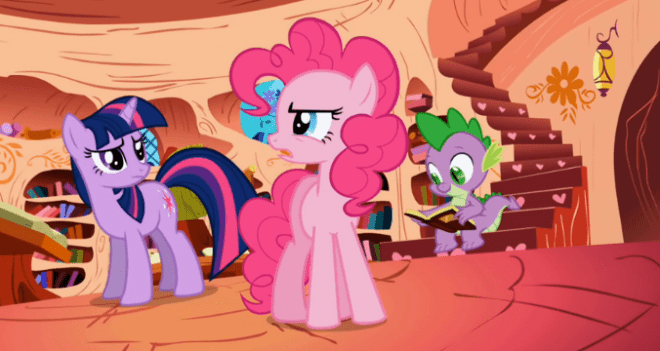
At least Twilight was listening this time.
So Pinkie eventually decides to bite her tongue, which really says a lot for her character (even if Twilight can’t appreciate the magnitude of the gesture or even that there was a gesture, Pinkie having stomped off in anger): despite Gilda being just some jerk who threw her off a cloud as far as she’s concerned, Pinkie is willing – or rather, able to force herself to be willing! – to give Gilda the benefit of the doubt, over and over, until the script piles on Gilda’s villainy so thickly and bluntly that any room for reasonable doubt is completely extinguished. Rainbow Dash remains oblivious, as she must, for the sake of the story.
Possibly, this course of action was only adopted in the first place because we’ve just established on-screen that Pinkie and Rainbow have not been close friends for very long, while Rainbow’s friendship with Gilda is (we’re told, but not shown) longer-established, and so any conflict based solely on Pinkie’s say-so would have been awkward and unrealistic, or taken the story in a different direction as it became a story of Pinkie’s word against Gilda’s – both weaker options, for my money, than what we eventually end up with.
Nonetheless, if it was a case of the writers painting themselves into a bit of a corner having made Gilda out to be a complete tool, the decision to avoid a public showdown, keeping Rainbow in the dark regarding her two friends not getting along, was a happy one for the sake of the episode and for our perception of both Pinkie and Rainbow.
Effectively, the entire second act (in terms of where I’ve drawn the breaks, anyway – without a script, this is just an unofficial personal interpretation and entirely subject to me being an idiot!) consists of Gilda being increasingly unpleasant and Pinkie trying her darnedest not to judge her, continuing to try to see the best in Gilda, even as the evidence mounts up she was correct in the first place.
There’s no room left for subtlety here, which leaves us without all that much to say; the script pushes us and pushes us until we’re left in no doubt whatsoever. Gilda makes a nuisance of herself throwing her weight around in the town square, Gilda steals from Granny Smith, Gilda nearly stomps on some baby animals, Gilda makes Fluttershy cry. That last one is the kicker – and on first viewing, I really appreciated the little callback to the earlier scene where Pinkie established that upsetting Fluttershy is strictly off-limits, and the resulting contrast between Gilda and Rainbow Dash. (Despite my misgivings about how quickly Gilda has to be written into being a pantomime baddie for it all to work, you can’t deny this whole episode is impressively tightly plotted in the way it joins up its individual structural elements.)
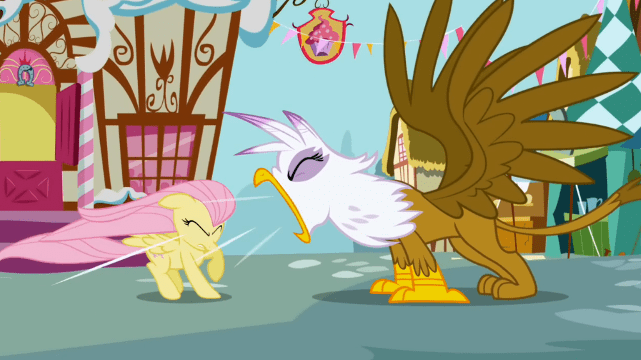
Oh no she DIDN’T.
Finally, Pinkie is satisfied she called it right: there are no hidden depths or mitigating factors on show here, Gilda is simply not a good person. Griffon. Whatever.
She’s a grump, and a thief, and a bully – the meanest kind of mean-meanie-pants there is! I can take it, but no-one treats Fluttershy like that. NO-ONE.
This calls for extreme measures – Pinkie Pie style!
Now it’s time to do something about it.

In which Pinkie Pie gets even in the best possible way
But that’s a setup which could easily wrap up the entire episode in a few moments, if need be; it takes some real writing skill to turn this situation around and eke out some more conflict before the inevitable coming showdown. Gilda has shown herself to be unpleasant not only in private with Pinkie, but also in public in town (which indicates again, incidentally, that she’s possibly never visited Ponyville before), which all but guarantees she’s going to be exposed by somepony, especially when we see the final scene is set at a party with the entire cast in attendance –
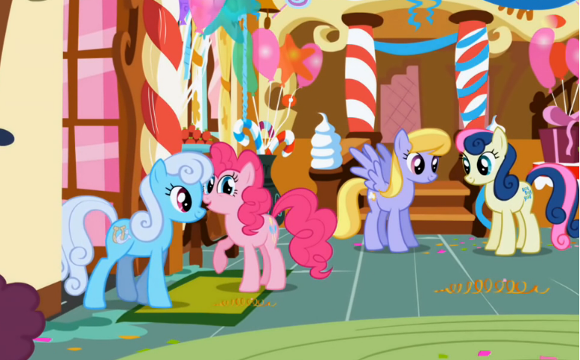
“Hey, look over there – it’s that asshole griffon from the town square!”
– and that means a confrontation with Rainbow Dash will almost surely occur as a result, right? (Barring a leftfield script choice where Gilda somehow sees the error of her ways and leaves town without Rainbow finding out what she’s done in order to spare Dash’s feelings, or something.) But no. How to extend the episode other than it being a slow-motion car crash of certain cringe? Time for an excellent bait-and-switch finale.
Who’s this “Gilda” I’ve heard nothing about?
(I laughed, anyway. And what’s with Applejack not knowing who Gilda is – Rainbow never introduced her, or even mentioned her? This “old friend” thing is getting shakier all the time.)
Pinkie Pie, hurt by Gilda’s completely unnecessary hurting of Fluttershy’s feelings, gets her true Pinkie on. Whether this is episode 3 or episode 5, we haven’t yet seen what’s under the surface, what happens when you poke the party pony, but the setup is pretty ominous, to the point where me and the children were all tensing up in anticipation of what was surely about to go down:
Umm… Pinkie Pie? About this party for Gilda… um… do you really think it’s a good idea…? I mean…
(beat)
(sotto voce) …I’m a year older than you.
Pretty clear, right? This is kids’ TV, and Gilda must not be allowed to get away with being a moral vacuum. Stealing, assault, making Fluttershy cry… these things can’t go unpunished. Pinkie Pie will sort her out but good.
Gilda! I’m so honoured to throw you one of my signature Pinkie Pie parties! And I really, truly, sincerely hope you feel welcome here, amongst all us ponyfolk.
Now you’re for it.
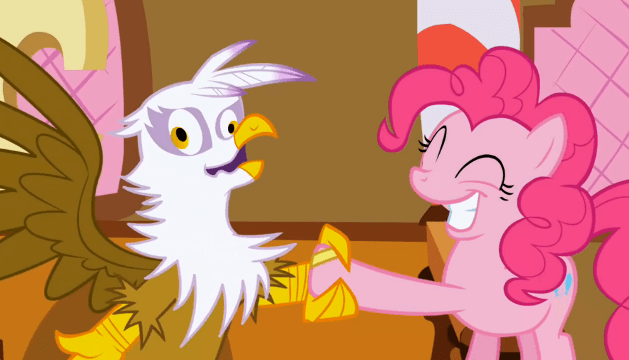
Gotcha.
(Note the difference in reaction between Rainbow Dash and Gilda when being pranked by Pinkie – they both deliver the exact same line, but while Rainbow clearly hasn’t given it a second thought, Gilda is clearly smouldering with quiet rage.)
So, the setup is clear as day, and we feel pretty confident we can predict what follows: Gilda is going to encounter an assault course of comeuppance at the hands of Pinkie, who gets to indulge her hitherto-unseen darker side in planning the party from hell for the guest of honour. Right?
Wrong. Instead, we get a very subtle affirmation of yet another oldie-but-goldie moral lesson: two wrongs don’t make a right.
If You Didn’t Come To Party,
Then Why Did You Come Here?
So, yes, after a whole act of Gilda being unstintingly horrible to everypony in general and Pinkie in particular, it’s kind of satisfying to see her not only being repeatedly pranked, but also hoist by her own petard. Having loudly proclaimed she was game for a laugh (when, as we know, that’s a prerequisite for being one of Rainbow Dash’s jock friends!), she can’t now put up a fuss at being made the victim of these pranks. She’s trapped herself.
It’s all going well, this “revenge” plan! Gilda is put through a series of public humiliations, falling into trap after trap – a dribble cup, wasabi lemon drops, fake birthday candles – and all the while, she’s stuck having to laugh them off every time, with markedly less good grace each time. The low point comes when Gilda loses her cool and resorts to physical violence, which is uncomfortable however cartoonish and unperturbed Pinkie’s reaction (though it helped that nobody else ever responds in kind, underlining to the children that only assholes think it’s OK to behave like this):
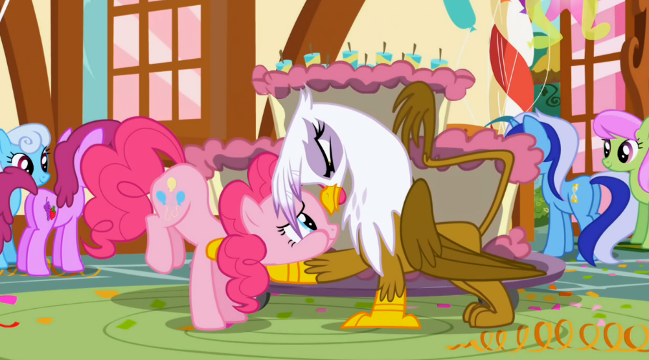
This would be much worse if Pinkie weren’t so totally indifferent.
Gilda’s inept attempts to bully Pinkie using verbal insults are as doomed to failure as her physical threats, because Pinkie is, as we already saw earlier, either completely oblivious or superbly unruffled when she’s being insulted, but it’s unpleasant all the same.
I’m not entirely sure just where Gilda crossed over the line from being a total pain to being genuinely malicious, but by this stage there’s no doubt at all that she’s well and truly crossed it. She’s not even remotely sympathetic now; she’s just a thoroughly nasty piece of work, getting drunk and violent at a party and threatening the host.
(Who just so happens to be the most popular pony in town, beloved by all and surrounded by two dozen of her closest mates, including an unnaturally strong earth pony and the most powerful unicorn in Equestria, who in turn happens to be a close enough friend of Princess Celestia to potentially elevate a ruck started by a foreign tourist at this party into an international diplomatic incident. It may become repetitive to see Gilda stepping on all of these rakes, but surely we’re all on Pinkie Pie’s side here as she apparently and deservedly puts Gilda through the wringer…?)
Gilda’s rage even pushes her into self-pranking, turning an entirely innocuous game of “pin the tail on the pony” into another opportunity to hurt hurself. Finally, inevitably, she can take no more, exploding in a spectacular (and spectacularly ill-conceived) outburst against everyone in the room who isn’t Rainbow Dash:
But… This is sort of you losing your cool, isn’t it?
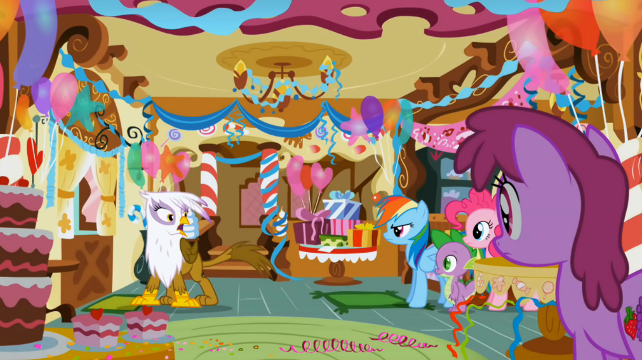
After a stunned silence, Rainbow Dash comes forward, so very not amused. And here’s the brilliant twist which neither me nor the children saw coming: it turns out that, actually, other than the initial hoof-buzzer, none of those other pranks were set up by Pinkie Pie. Rather, they were all laid by Rainbow Dash, and for the “benefit” of every guest at the party, as a continuation of her Act I prank-spree. She had no expectation Gilda would somehow set off each one of them in turn.
Completely innocent, Pinkie, true to her nature, just wanted to throw Gilda a really nice party to wipe the slate clean, and the business about “extreme measures” and Gilda being “taken care of” were red herrings.
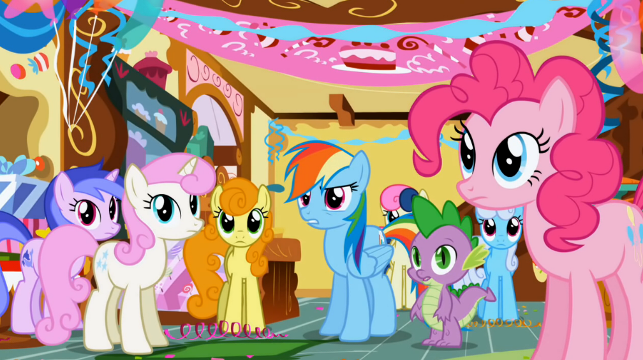
Oh, it’s awkward. It’s so awkward.
The twist is unexpected and well-executed, especially watching back again on repeat viewings once you know the twist. The writers by and large play fair; Pinkie whipping out a marshmallow to be toasted initially feels like a cheat considering she’d have had no idea Gilda was about to belch fire, but on reflection it feels like exactly the sort of inexplicably random thing Pinkie might do. (Bad writing or excellent bonus? You decide. I’m going with the latter.)
On the one level, this simply puts a lid on Gilda’s completely untenable position, leaving her not only livid but trapped: the truth is out and her friend knows she’s an abusive sociopath. On another level, even more interestingly, she didn’t initially care too much about that part of it, because she thought Dash wouldn’t care too much either. Gilda has catastrophically misjudged Rainbow Dash, believing she’d up and leave the party to keep hanging out, in the process perhaps showing how little Gilda truly knows her (or, alternatively, how much Rainbow has changed).
Rainbow’s Element being loyalty – and we’re still unclear as to what “Element” means in this context, even five seasons later: defining trait? Strongest talent? Just the specific thing they happened to teach Twilight about in the second episode? – is one of the hardest things to translate to simple moral lessons. Being loyal can be good, but it inevitably conflicts with the need for honesty, because a yes-man isn’t always being a good friend. Similarly, loyalty is ambiguous, because what happens when loyalties conflict? Who can serve two masters equally well? It’s a rich vein of more nuanced lessons, and more directly applicable to watching children’s real-world conundrums. How far can “loyalty” take you when someone is just being an out-and-out jerk?
So here, Rainbow’s loyalty to her new friends easily outweighs her loyalty to her old friend, and she explicitly says so:
You sure didn’t need any help making a fool of yourself! Y’know, this is not how I thought my old friends would treat my new friends. If being “cool” is all you care about, then maybe you should go find some new, cool friends someplace else.
And it’s a fair point, because, as the episode painstakingly already established, to be Rainbow’s friend you have to genuinely be cool with Rainbow expressing her affection through the medium of her making you look silly. Pinkie Pie, it turns out, with her apparently flameproof disposition when it comes to being a prank victim, might actually be the perfect foil for Rainbow Dash after all. Where does that leave Gilda? She is emphatically not the friend Rainbow Dash is looking for; maybe Rainbow Dash is not the friend Gilda is looking for either, and this is the moment they both realise it. They’re both hard work, and maybe they’re both better off away from each other. For sure there’s no room in Ponyville for a jerk like Gilda, and so all that’s left is a sad attempt at saving face as she slams the door behind her:
Yeah, good luck with that.
All that’s left is to wrap things up; Rainbow is in the apparently familiar position of having to apologise on behalf of a boorish friend (kids, this is something which will happen a lot if you hang out with jerks!), while Pinkie – who didn’t get to be the town’s resident party pony by accident – knows exactly how and when to intervene in order to get the party going again with minimum awkwardness:
Any other show, they’d say “no hard feelings” and then hug to prove it. But we’ve already got a pretty good handle on this relationship now, so it feels much more believable when they say “no hard feelings”, this is what happens:

You two deserve each other. And I mean that in a positive sense.
After The Fireworks
And that’s pretty much it for episode 3. Just time for a new tradition to start: Twilight’s letter to the Princess detailing what she’s learned about friendship from these events, followed by optional gag. From my perspective, the first friendship lesson report Twilight submits, even if it doesn’t exactly cover all the valuable pointers from the episode, is right on target when it comes to distilling the moral:
Though it’s impossible to control who your friends hang out with, it is possible to control your own behaviour. Just continue to be a good friend.
Like I said, I don’t believe this came as a new idea to any brony watching, but when someone’s being abusive, as a friendly reminder, it’s not a bad lesson whatever your age. Life’s too short to intentionally spend it in the company of wankers, or to sink to their level. And regardless of what may happen in the future – fans have been awaiting Gilda’s return for four seasons now, maybe in the hope of getting additional closure, maybe in the hope of just getting to know more about griffons – it’s pretty remarkable that there’s no attempt here to reform Gilda, no sobbing apology, no post-mortem inquest into her friendship with Rainbow Dash, no explanation at all, just a jerk who gets called out for being a jerk, and who Rainbow promptly cuts out of her life.
The little pre-credits gag (Princess Celestia begins to write a reply, and then realises with a chuckle that she’s trying to use the invisible ink from earlier in the episode, which arrived with Twilight’s letter) is another nice moment of levity, puncturing the fearsome figure Celestia cut in the pilot – time and again this series, we’ll see the apparently implacable, apparently invincible godlike authority figure showing a humourous streak, and this is a nice start. (Did she get pranked, or did she request the ink in readiness to prank someone else? Either way, she’s amused, which is lovely to see.)
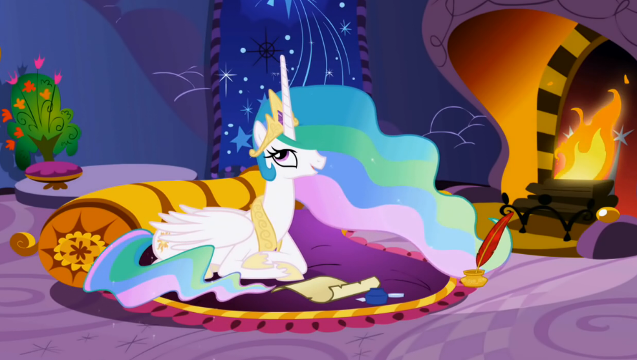
If the show was just 22 minutes of Celestia chuckling good-naturedly at things, I’d still watch it.
So, that worked absolutely perfectly as a third episode – I’m not even sure it’s not a better third episode than The Ticket Master in terms of pushing these characters forward. Certainly it did its job in showing what the show could really be like, freed of the need to introduce both a world-level quest and a cast of characters; concentrating solely on the latter, it works very well indeed.
For those keeping score at home, after three episodes in a single day, I’d gone from a feeling of dread (both that my daughter should not be watching My Little Pony, and that the resulting show was going to be awful) to a tacit acknowledgement that this wasn’t bad at all. The kids really liked it, and later I’d explain the feelings I was having pretty simply, although I didn’t recognise it at the time: I really liked it too.
The thought that clearly went into this episode, and the feeling (soon to become familiar!) that the creators seemed to have put in considerably more effort than strictly required to make the result acceptable, were already sowing seeds of admiration. By this point, fears assuaged, I was actively looking forward to watching episode four. Or, you know, eight. Whatever.

PONYWATCHING
 |
 |
 |
| Full Length Reflections
Long essays on every episode |
Shorter Reflections
Condensed, more traditional-style episode reviews |
Pony Notes
Thoughts on various pony-related themes, Top 10s and the like |
Ponywatching Home
PREVIOUS |
NEXT |
| “1-02: Friendship is Magic, Part 2” | “1-08: Look Before You Sleep” |
I’d love to hear your own thoughts and comments below – all opinions are welcome and dissent is encouraged!
Alternatively, there’s a lot more discussion and comments on the Reddit post for this essay:
Reddit – /r/mylittlepony on Ponywatching 1.05

