



Episode written by Cindy Morrow
Wholly subjective reflections by sixcardroulette
This is The Shorter Ponywatching. For a really long, in-depth essay
on this episode, check out the full length reflection!


The third episode we ever watched, thanks to wacky British DVD scheduling, this works so well as a follow-up to Mare in the Moon that we didn’t even notice the incorrect order.
This episode is made up of two distinct storylines, each taking up roughly half the running time, bound together with no small amount of skill: first, Pinkie Pie and a reluctant Rainbow Dash become firm friends following a spree of practical jokes, and then Rainbow is visited by an old friend who disrupts the new group dynamic and takes a dislike to Pinkie. The first “slice of life” episode we ever encountered, a sitcom-dramedy focussed solely on interaction between the main characters rather than an external fantasy threat, this is an episode that really helped hook me in during our earliest days of watching the show.

More than anything, this one for me cemented the idea that the events of Mare in the Moon (where the team defeated the villain Nightmare Moon with magic derived explicitly from the power of their combined friendship) marked a starting point for these characters’ developing friendships, rather than serving to establish they were all now the best of friends having gone through such an extreme bonding experience.
The complex web of relationships between the various individual members of the Mane 6, and the idea that friendship is a two-way street (where two people ponies can have very different ideas about the strength of their friendship), is underlined right from the start here. At this stage, they’re all united by knowing Twilight Sparkle, and (in some cases) not very much else.
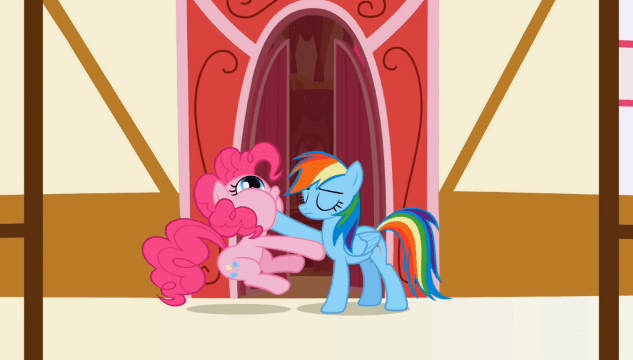
Pinkie Pie, the fourth-wall-bending party girl about whom we came out of that opening two-parter knowing virtually nothing, and Rainbow Dash, the sporty, egotistical tomboy, just saved the world together. But they’re only friends in Pinkie’s head (and that’s because, in Pinkie’s head, she’s friends with everypony); Rainbow is visibly irritated by her presence, and spends both the cold open and the opening moments of the first act trying fruitlessly to get away from her on two separate occasions (even flying head-first into a rockface) before conceding defeat.
But here’s where the show distinguishes itself from lesser children’s offerings, and indeed from many adult sitcoms. Instead of just telling us “look, these two ill-matched ponies are good friends” and expecting us to buy it on trust, Griffon The Brush Off goes to show how these two could feasibly be friends in real life. It does it by examining just what friendship means to both Pinkie and Rainbow, and what they have in common. Show, don’t tell.
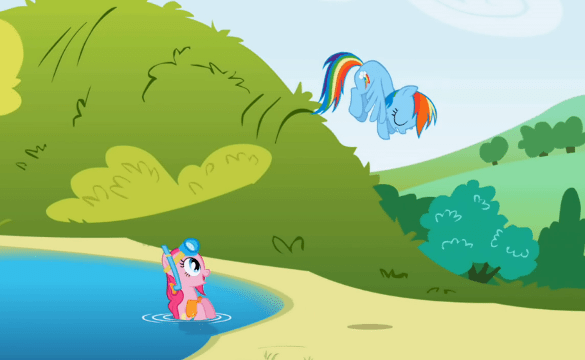
For Pinkie, friendship is paramount, and while the way she’s portrayed varies from writer to writer, she’s not just a two-dimensional joke dispensing machine; the key to her personality (which we’ll see so beautifully expressed in song form next season) is making her friends smile. As soon as she works out that the way to Rainbow’s heart is through her sense of humour, the path is cleared, and the resulting bonding (over a spree of pranking the inhabitants of Ponyville) is entirely believable. Once Rainbow understands Pinkie can take a joke as well as dish it out, apparently the #1 prerequisite for Rainbow considering you a friend (remember how she met Twilight in the first episode!), it’s settled.
It may take up almost half the episode, but consider: this show was willing to burn half an episode to properly establish something they could have just told us via clunky exposition, but they took the time to do it properly, and the resulting friendship feels not only more realistic but more enduring.
The rest of the episode is concerned with the arrival of Gilda the griffon, an old friend of Rainbow’s (just how close a friend is left open to debate), who takes a dislike to Pinkie after she tries to interrupt their catching up one too many times. Gilda starts out an interesting and well-drawn character, raising some valid points – Pinkie is annoying, and Gilda’s irritation at wanting to spend her time visiting with Rainbow Dash without a third wheel is legitimate, and that’s before we consider how insecure Gilda herself might be in her friendship with Rainbow Dash.
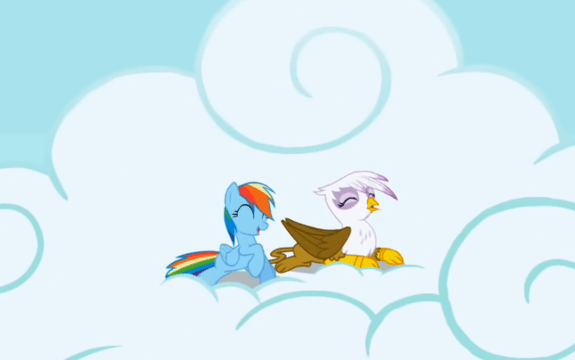
All interesting and very real, and it makes for a nuanced situation which, on first viewing with the family, we all wondered where this was heading. It’s a little disappointing, then, that they fall back on an easy-way-out explanation: instead of being a complex individual with some entirely valid concerns, any of which could be extrapolated into a valuable exploration about friendship, leading to lessons about how friendships change over time, or how your friends’ friends aren’t always your friends, or how you shouldn’t judge someone on a bad-context first meeting if your friends are vouching for them, Gilda turns out merely to be a total douche.
But it’s really the only easy way out this episode takes. Just like the opening two-parter, we repeatedly get visions of a less-good version of the show, fears which are quickly assuaged, clichéd resolutions by and large avoided. This isn’t an episode about taking pranks too far, or having to choose between friends, or two wrongs making a right, or – and this is the one that really impressed me – how everyone, even bullies can change and become good friends.
In fact, the moral of this one is the exact opposite: some people ponies are just abusive jerks, and if they don’t knock that crap off, you need to cut them out of your life.
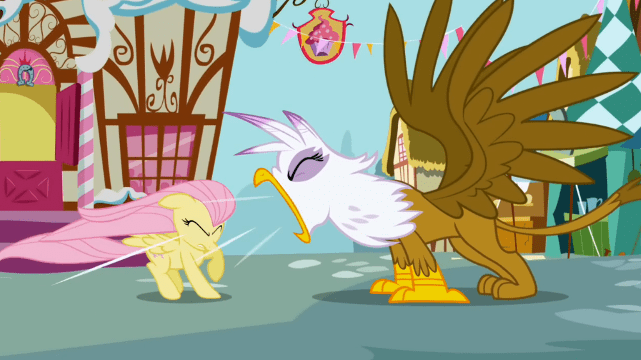
Gilda is a physical and emotional bully who’s obnoxious to every single pony she meets; Pinkie originally has her doubts and (after a consultation with Twilight Sparkle) even admits to herself the possibility it could all be jealousy on her part, but no, Gilda is just genuinely horrible. It’s only ever a matter of time before Rainbow Dash finds out, but rather than jump straight to an obvious showdown and conclusion, we instead get a great bait-and-switch finale, another hint that this show is interested in taking things beyond the functional and strictly necessary.
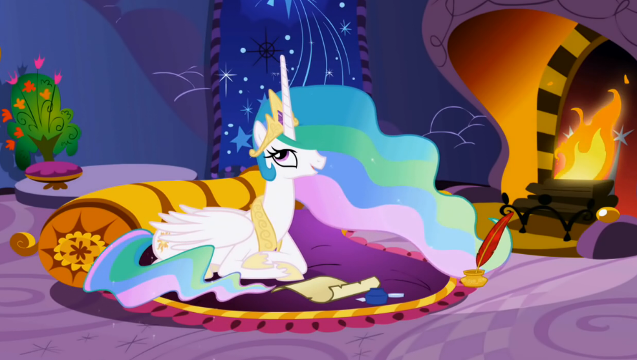
Pinkie, giving off lots of hints about revenge, throws Gilda a party at which the griffon is subjected to a series of public humiliations, resulting in her losing it in spectacular fashion and loudly berating Pinkie – whereupon Rainbow Dash steps forward and reveals she laid all those pranks (which, clever callback, is what she thinks friends do to each other, remember?), and that Pinkie really was just trying to turn Gilda’s frown upside down with a nice party. Defeated, Gilda slinks off, Rainbow apologises to her new friends, Twilight Sparkle sends Princess Celestia our first “friendship lesson” of the series, and after a nice little vignette with the Princess enjoying a joke of her own, that’s three episodes down.

I really liked this one. It’s a pity Gilda has to be flattened from a rounded character to a hostile villain just because the story (not the script, the actual structure of the Pinkie-and-Rainbow story) calls for an outsider to be a jerk, and there’s no room for doubt (though the door is left open for a redemption in the future, something that hasn’t happened yet as of the time of writing). But the resulting study of how friendship happened between Pinkie and Rainbow, one of the most unlikely pairings of the Mane Six, is worth the trade-off. (I say “one of”; we’ll have the other deeply unlikely pairing, Applejack and Rarity, up next. Thanks, British DVD compilers!)
The moral lessons in this one, which pile up thick and fast, are good stuff. Originally, when I discovered bronies were a thing after looking up the show online some time in February, I was confused by the idea of adults taking advice from this kids’ show to heart, but then I realised there’s more to it than that; these “lessons” don’t teach anything new, but they serve as reminders, jolts, re-stating basic principles for those who can’t see the wood for the trees. Twilight’s writing letters to the Princess is a pretty forced way to get the supposed E/I nature of the show approved, but this “first” one sums things up really well, and I like it better than the two we should already have seen.
(Also, Princess Celestia’s good-natured chuckle when she realises she’s been writing with invisible ink is just adorable.)
Really, this whole episode just feels very well thought out; Gilda’s necessary Flanderization aside, the characterisation is strong, the show takes extra effort in all departments compared to the sloppy approach to storytelling in other kids’ TV (there’s a lot of it out there, childless bronies!), and it’s well-constructed. Having started the day with no enthusiasm for My Little Pony and no small amount of hostility, after these three episodes I was already looking forward to seeing where it’d take us in episode four. Or eight. Whatever.

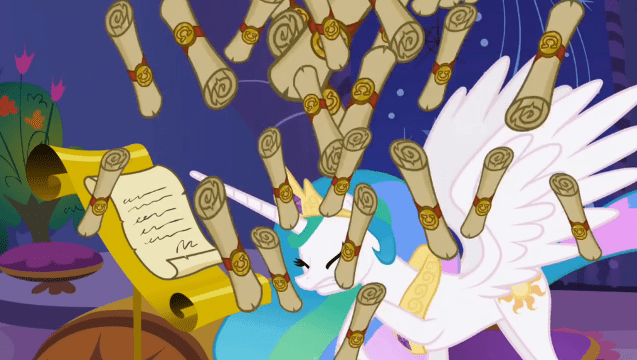
While Pinkie and Rainbow’s prank spree is a lovely moment for character development, it’s pretty hit-and-miss on the comedy front; even my kids weren’t terribly amused by most of their 1930s schoolboy antics. However, the leap of imagination which causes Spike’s hiccups to accidentally spam Princess Celestia with hundreds of unwanted messages genuinely made me laugh, so I vote for that.

Though it’s impossible to control who your friends hang out with, it is possible to control your own behaviour. Just continue to be a good friend.
I have mixed opinions on some of the lessons this season (and how they were arrived at as valid conclusions from the events of their preceding episodes), but this one’s absolutely fine by me.

This might well make a better third episode than The Ticket Master; it’s great to see Rainbow and Pinkie explored more thoroughly as characters, the development of their friendship dynamic is wholly believable, and there are some funny jokes. If Gilda has to be sacrificed as a fleshed-out character for that story to happen, so be it.

Impressive in its repeated refusal to take the obvious, easy way out.

PONYWATCHING
 |
 |
 |
| Full Length Reflections
Long essays on every episode |
Shorter Reflections
Condensed, more traditional-style episode reviews |
Pony Notes
Thoughts on various pony-related themes, Top 10s and the like |
Ponywatching Home
PREVIOUS |
NEXT |
| “Friendship is Magic, Part 2” | “Look Before You Sleep” |
I’d love to hear your own thoughts and comments below – all opinions are welcome and dissent is encouraged!
 Ponywatching